Saturday, November 3, 2012

Just like lanterns


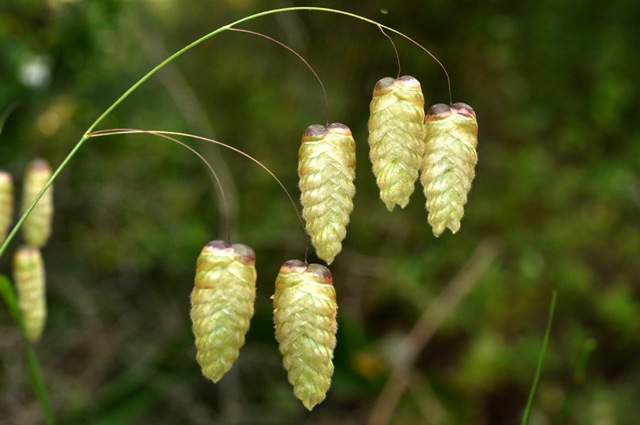
Quaking grass
The flowers of the large quaking grasses look like delicate lanterns hanging at the end of a thin arching wire. 

They are so light that the gentlest of breezes is enough to start them nodding. 


Waiting for the flower-heads to stop bobbing for long enough to take pictures is a game of patience.


The quaking grass genus consists of about twelve species some of which are widely cultivated. 

Two species have been recorded in the Maltese islands. 


One species is indigenous while the other has become naturalised. 


The indigenous species is known in known in Maltese as beżżulet il-qattusa, cat’s nipple in English. 


It flowering between March and May but the dry flowers can still be found hanging on the plant for several weeks after the end of the flowering season. 


It is a relatively common plant that grows in rocky parts of valleys. 


I have recently seen it at Busket, Wied Dalam and Fiddien. 


It is native to southern Europe and North Africa as well as western Asia. It is a very popular garden plant and is grown as ornament in most of the world as a result of which it has become naturalised in the British Isles, Australia and the Americas including Hawaii.


Quaking grasses belong to the grass family. 

This very large family consists of more than 10,000 species. 


About one hundred are found in the Maltese islands. 


The grasses are the fifth largest family in the plant kingdom. 


They are found in a variety of habitats and are the dominant species in grasslands which themselves cover about 20% of the land surface.


They are extremely important commercially as they provide humans with the most important staple foods particularly grains and cereals.

Lawns and turfs are made of grass species as is bamboo which is used as a building material in large parts of east Asia and sub-Saharan Africa.

This article was published in The Times on 16.05.2012

Emblem of hope


The hawthorn
Hawthorns are large bushes or small trees that belong to the rose family and are native in Europe, Asia and North America. 

These trees y are an important source of food plants for birds and insects. and are often planted by naturalists to attract wildlife.


Hawthorns are at their best in spring and autumn, most pictures of these small trees show the trees in autumn when their branches are laden with small apple-like fruit. 


The fruit is beautiful to look at but its function is not to please us but to attract thrushes and other birds and entice them to eat the fruit so that they would help disperse the seeds. 


Same is true in spring. The pleasant fragrance released by the beautiful white flowers of the hawthorn attracts large numbers of insects which are important for their pollination.


The name hawthorn is now used for all species in this group of plants but it was originally used only for one species that is common throughout most of Europe including Malta.

In Maltese it is called żagħrun. This species grows wildly in the Maltese countryside but is usually noticed only in autumn.


A less common species, the Crete hawthorn, is known in Maltese as għanzalor. 

Although this species is found in other Mediterranean countries it is not known whether it is indigenous to the Maltese islands as it might have been brought and planted here for its fruit. 


Sometimes one can also meet hybrids which are known in Maltese as għanżalor bagħal.


The hawthorn was commonly used in traditional medicine and is still being studied as a source of antioxidants and other phytochemicals which can be used as a cure for a number of medical conditions including cardiac insufficiency. 

The fruit can be made into jellies, jams and syrups and to add flavour to brandy. The petals can also be used in salads.


It is inevitable that such a popular plant would have many important folk traditions surrounding it. It is the emblem of hope and in parts of Britain and Ireland it was considered unlucky to uproot it. 

This article was published in The Times on 09.05.2012

Tree mallow

Tree mallow
In Malta several species of mallow are found growing wild. They are known as ħobbejz, a word of Arabic origin meaning small loaf.

The name was presumably given to it because of the seed pods which have the shape of a loaf. A similar name is used for the seed pods in Jersey where they are known as “petit pains”.

The English name mallow comes from Old English malwe which itself comes from the Latin word malva

The Latin name is itself derived either from an old Greek word for yellow or from a Hebrew word which sounds like the Maltese word melħ and which like the Maltese word means salty.


In 1859 the French name for mallow, mauve, started to be used for a colour.


This plant should be instantly recognizable, yet, most people hardly notice it growing along roadsides and in abandoned fields especially close to the coast. It can grow up to two metres high with strong woody trunk which in Malta would qualify it as a small tree.

It has large leaves and from March to June unmistakable brightly coloured flowers. It grows along the coasts of Western Europe and the Mediterranean as far east as Greece. It is often very common on islands.

The tree mallow (ħobbejża tas-siġra) can grow in environments with high salinity. Like the tamarisk tree, known in Maltese as bruka, it can survive in these difficult conditions because it is able to excrete salt through glands on its leaves.


In many parts of Europe the leaves of the tree mallow were used to make poultices which were used to treat sprains and burns and in some places they are still used as animal fodder. 


They have also been used as an alternative to toilet paper.


In the Middle East the leaves are used in a traditional Arab dish known as khubeza


This article was published in The Times on 02.05.2012

The star of Bethlehem


Plant and animal names are a fascinating subject and can be a good topic for research and studies. 


The large star of Bethlehem, a spring-flowering plant, is a case in point.


In Maltese this flower is known as ħalib it-tajr kbir, a distinctive name for a beautiful flower but this is probably not the name country people used when referring to it. 

It is also known as ħara taċ-ċawl meaning jackdaws’ faeces. 


A hundred years ago such a name would have been considered as too rude to be used in print. 


The authors of a book on Maltese flora written in the early 20th century left the name of this species out from their book. 


Sometime later somebody coined a new name by using its scientific name Ornithogalum and translated it into Maltese. 


Ornithogalum is made up of two Greek words ornis meaning bird and gala meaning milk  a name given to it because of its white flowers and because ‘birds’ milk’ was used by the Romans to describe wonderful things, hence ħalib it-tajr.


The white flowers of the large star of Bethlehem open on a stalk that is about thirty centimtres high which is just tall enough for the flowers to stand above the surrounding vegetation. 

It belongs to a family of bulbous plants found mostly in Europe and southern Africa. The family consists of about 150 species although not all are large and showy as this species.


Two other species, which also flower in spring, can be found in the Maltese islands. Both are much smaller.


The lesser star of Bethlehem known in Maltese as ħalib it-tajt skars was believed to be extinct but was found again less than ten years ago near Buskett. The other species, the southern star of Bethlehem, ħalib it-tajr żgħir in Maltese, is frequently found in rocky areas especially in late spring when much of the vegetation has dried up. 

This article was published in The Times on 25.04.2012

The yellow-legged wader


The wood sandpiper is a wading bird seen in the Maltese islands during migration. It is one of the smaller waders with a short fine bill and yellowish legs. 

Several species of waders visit the Maltese islands. To the uninitiated they might all look the same but with a little practice and experience identifying these birds becomes second nature.

The best place to see migrating wood sandpipers and other waders in Malta is at the Għadira Nature Reserve near Mellieħa which is open t the public on weekends but to see them breeding you would have to travel north at least as far as Scandinavia. 

The nests are built on the ground in open swampy areas in northern forests, but as the summer season so far north is very short you would have to be there between May and mid-July. 

The start and finishing dates of the breeding season depends on how far north they are. In northern Russia for example breeding does not start before June.

Some adult green sandpipers start migrating south as early as late June. 

Young birds remain behind for longer and usually leave in late August. 

This gives them time to become fully grown and to build up their fat reserves which will provide them with the energy required to fly south. 

European and many Asian wood sandpipers spend the winter in Africa. 

On their way south they stop to feed and replenish their fat in suitable places. 

Wetlands north of the Mediterranean are of great importance for these birds as the reserves they build make it possible for them to cross the Sahara desert without the need to refuel.

When stopping to feed, migrating sandpipers keep themselves busy walking continuously along the water’s edge or in shallow waters, picking up tiny aquatic insects from the mud or from the water’s surface.

Wood sandpipers have a very large breeding range and they are not considered as being endangered although climate change is seen as a threat as this could result in their specialised habitat shrinking in area.

 As the earth warms up these birds might have to travel further north to find suitable breeding sites. 

This article was published in The Times on 18.04.2012


The endemic spider orchid


The Ophrys melitensis or Maltese spider orchid (brimba sewda) is one of twenty four species of plants endemic to the Maltese islands.

It is one of a small number of insect orchids that flower in spring. This orchid has a velvety reddish brown petal with variable metallic blue markings in the centre of it.

Another endemic orchid is the Maltese pyramidal orchid (orkida piramidali ta’ Malta) but the best known Maltese endemic is Malta’s national plant, the Maltese rock centaury (widnet il-baħar). 

It was first described by Stefano Zerafa a Maltese doctor with a keen interest in the botany of the Maltese islands.


The word endemic is often confused with indigenous. An indigenous species is a plant or animal that is native in a particular place. The opposite of indigenous is non-native. 


In the Maltese countryside we find many species of non-native species including the Cape sorrel (ħaxixa Ingliża) a native of South Africa which was introduced in Malta in the early 19th Century.


Endemism on the other hand means that a species is found in a defined area. Thus Maltese endemic plants and animals are found in Malta and nowhere else in the world.


 There are also regional endemics. In the case of Malta these would be restricted to Malta and some small neighbouring islands such as Lampedusa, and Pantelleria or Sicily.


Many endemic species are found on islands as a result of biological isolation which allows a species to evolve separately and differently from the same species in another area. 


The number of endemic species in the Maltese islands is lower than on other Mediterranean islands. 


This is probably a result of millennia of human pressure which must have led to the extinction of many species.


Endemic species are considered as internationally important. 


Because of their restricted range they are often in danger of extinction or given a vulnerable status are often protected by means of national and international legislation. 


This article was published in The Times on 11.04.2012

Thursday, November 1, 2012

How the wild rabbit was tamed


The wild rabbit is not indigenous to the Maltese islands but it has been here for so long that it is now considered as part of the Maltese fauna. 

The rabbit originated in the Iberian Peninsula.  


From there it was taken to other countries and is now found throughout Europe. I


t was probably introduced in Malta by the Romans or possibly by the Phoenicians. 


Malta was one of the stops of the Phoenicians as they sailed across the Mediterranean their western colonies and their homeland and they could have released rabbits on the Maltese islands to ensure a supply of fresh meat during their journeys. 


The rabbits survived in the Maltese countryside and eventually provided meat for the local population. 

The Knights of St John issued several edicts to restrict or prohibit the local population from hunting rabbits.


In 1773 the restrictions even resulted in a revolt known as the Rising of the Priests.

It is not known when rabbits started to be domesticated in the Maltese islands. 

Some farmers used to keep a doe enclosed with four stone walls each between 80 and 100 cm high. 


The doe was well fed and was too heavy or too lazy to jump out. Males on the other hand would jump inside at night to mate. 


This provided the farmers with a supply of meat close at hand. 


These rabbits were probably the progenitors of the local domestic rabbit known as ‘tax-xiber’.


Wild rabbits are usually a pale sandy brown or greyish with white underparts and different colour varieties can be found in the same area.

Wild rabbits are still relatively common in the Maltese countryside but they are rarely seen because they emerge to feed at dawn and dusk and are very timid as a result of centuries of hunting. 

At the Għadira Nature Reserve, where hunting has been prohibited since 1980, many rabbits have become tame and active during the day and can be seen regularly by those visiting the reserve which is open to the public on weekends. 


This article was published in The Times on 04.04.2012