Showing posts with label briza maxima. Show all posts

Thursday, January 24, 2013

The large quaking grass

Large quacking grass (Briza maxima)

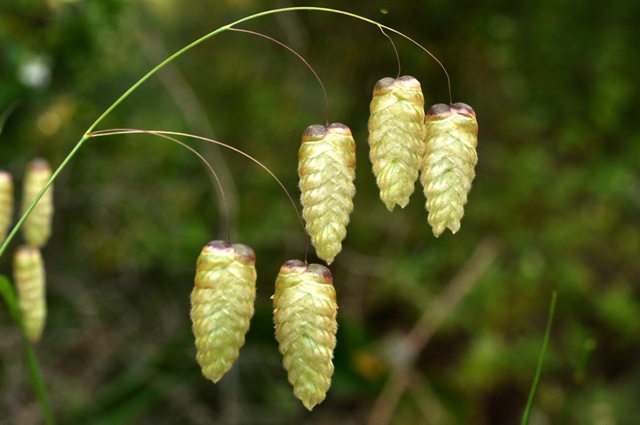
The flowers and seed heads of the large quaking grass look like small drooping Chinese lanterns attached to a slender stalk swinging to and fro in a gentle spring breeze. This species is an annual spring-flowering member of the grass family. It is found throughout the Mediterranean region and is cultivated in Britain, Australasia and many parts of the Unites States of America as a decorative garden plant and is often used in flower arrangements.

Known in Maltese as beżżulet il-qattusa, the large quaking grass is frequently found in garigue and other rocky areas such as maquis as well as along roadsides and in wasteland.
The grass family is a large successful plant family in which one finds many well known species such as rice, wheat and barley as well as the great reed, bamboo and a myriad of other species many of which are of economic importance.

Rice, wheat and maize provide more than half of all calories eaten by humans whilst another species, sugarcane, is the major source of sugar production. Of all crops 70% are grasses.

It is estimated that there are more than 10,000 species of grasses. Planted communities dominated by grasses are known as grasslands. Grasslands comprise about 20% of terrestrial habitats.

Grass blades grow at the base of the blade and not from elongated stem tips. This low growth point evolved in response to grazing animals and allows grasses to be grazed or mown regularly without severe damage to the plant. Without large grazers such as deer, elephants cattle and other livestock a clear-cut fire-destroyed areas would soon be colonized by grasses and if there is enough rain, tree-seedlings. 

The tree seedlings would eventually produce shade which kills most grasses. Large animals trample the seedlings, killing the trees. Grasses persist because their lack of woody stems helps them to resist the damage of trampling. 

This article was published in The Times on 6 May 2009

Saturday, November 3, 2012

Just like lanterns


Quaking grass
The flowers of the large quaking grasses look like delicate lanterns hanging at the end of a thin arching wire. 

They are so light that the gentlest of breezes is enough to start them nodding. 


Waiting for the flower-heads to stop bobbing for long enough to take pictures is a game of patience.


The quaking grass genus consists of about twelve species some of which are widely cultivated. 

Two species have been recorded in the Maltese islands. 


One species is indigenous while the other has become naturalised. 


The indigenous species is known in known in Maltese as beżżulet il-qattusa, cat’s nipple in English. 


It flowering between March and May but the dry flowers can still be found hanging on the plant for several weeks after the end of the flowering season. 


It is a relatively common plant that grows in rocky parts of valleys. 


I have recently seen it at Busket, Wied Dalam and Fiddien. 


It is native to southern Europe and North Africa as well as western Asia. It is a very popular garden plant and is grown as ornament in most of the world as a result of which it has become naturalised in the British Isles, Australia and the Americas including Hawaii.


Quaking grasses belong to the grass family. 

This very large family consists of more than 10,000 species. 


About one hundred are found in the Maltese islands. 


The grasses are the fifth largest family in the plant kingdom. 


They are found in a variety of habitats and are the dominant species in grasslands which themselves cover about 20% of the land surface.


They are extremely important commercially as they provide humans with the most important staple foods particularly grains and cereals.

Lawns and turfs are made of grass species as is bamboo which is used as a building material in large parts of east Asia and sub-Saharan Africa.

This article was published in The Times on 16.05.2012