Showing posts with label insect. Show all posts

Monday, October 19, 2015

Mason Bees

The mason bee is common in spring. It can easily be identified by the thick layer of reddish brown hair that covers its thorax, the hairless blackish brown abdomen and reddish legs. Females have an abdominal broom. This is a structure formed by fringes of hair which is used to collect pollen.

This species is found in western counties of the Mediterranean including Portugal, Spain, France, Italy and Malta as well as North African counties as far east as Libya. In Italy it is restricted to southern Italy, Sicily and Sardinia.

In Maltese the mason bee is known as naħla tal-koppla because of the rounded structure of its nest which looks like a church dome.

Mason bees are solitary bees but at this time of the year several can be seen close together on the ground especially in rocky areas, collecting gravel and small stones which they use to build their nests.

Females the building material collected from these places and cement it by mixing it with a secretion from their labial glands to form a mud. The mud is used to build rounded nests which are attached to walls or rocks. The labial secretion makes the dried mud impervious to water and the nest can last for many years.

The internal structure of the nest consists of several elongated cells which are filled with honey and pollen. An egg is laid in each cell. The larva forms a pupa which overwinters inside the nest. The adult bee emerges in early spring to start nest building and to collect pollen from flowers

The mason bee belongs to a family known as megachilid. Most bees belonging to this family are known either as mason bees or leafcutter leaves depending on the material they use to build their nests. A small number of species which collect plant or animal hairs and fibres are known as carder bees.

About fifteen species of megachiclid bees are found in the Maltese islands.
Megachiclid bees are inefficient pollen collectors. They have to visit several plants to collect sufficient pollen for their needs and this makes them very important pollinators. 

This  article was published in the Times of Malta on 16 April 2015. 


Sunday, March 9, 2014

The beetle that dwells in churches

Churchyard beetle - Blabs gigas - ħanfusa tal-kantina
The churchyard beetle is one of the larger beetles of the Maltese islands. Some individual specimens can grow up to 37mm long. It prefers to live in dark humid areas and can sometimes be found in basements, cellars, cave entrances and obviously churches.

In Maltese this common species is known as ħanfusa tal-kantina.

The front wings of most beetles are hardened and cover the abdomen and a pair of delicate wings. To fly, most beetles lift their front wings and unfurl the hind wings. The churchyard beetle cannot fly because its front wings are fused together and cannot be lifted.

Inability to fly could leave this species susceptible to many predators but it compensates for its inability to escape from danger by being able to secrete a pungent liquid from glands that are found in the joints of its limbs. Any bird or mammal trying to eat one soon learns to leave this disgusting insect alone.

Unpalatable insects such as the ladybird often have bright warning colours to make them easily recognisable. The churchyard beetle is jet black, probably, because it lives in dark places where colours would not be of any use.

When threatened the churchyard beetle can also change its posture to appear larger. It pushes its head against the ground and extends its hindlegs so as to tilt its body so that its wings face its enemy.

Several closely related species that lives in the Namib Desert on misty nights takes up a similar position to collect water which forms on theirs body. The body then trickles down their back to their head and mouth. 

The churchyard beetle belongs to a family of beetles known as the darkling beetles. A name they got because of their dark colour. The darkling is a large family with more than 20,000 members. In Malta about fifty species can be found a number of which are endemic to the Maltese islands. 

This article was published in The Times of Malta on 5 February 2014.


Saturday, December 28, 2013

Snapping nature at home

Nature photography is generally defined as the photographing of landscapes as well as plants and animals in their natural habitats. Purists do not consider any picture that includes man-made objects as a nature picture.
Some nature photography competitions stipulate that an image cannot be allowed to compete if it includes non-natural objects. This attitude would be commendable were it not for the fact that nowadays none of us live in untouched surroundings. Most of us live in towns and villages surrounded by buildings with little or no greenery.
For many the only nature they regularly come in contact is found in gardens and other man-made open spaces.  For them, nature consists of cultivated flowers, trees and nature programs on television.
On the other hand for those who are tuned to nature there is much more. As they walk through a street, they see wild plants growing wherever there is some soil. Wild plants grow even in cracks on pavements. Vegetation attracts wildlife and though we do not have large animals we have an interesting variety of insects and other arthropods. Some of which even enter buildings including our home.    
Sometimes unusual and interesting species such as the ant-lion end up in houses. Should one photograph an ant-lion on a wall? Yes, because although ant-lions normally spend the day resting on vegetation, the fact that it sometimes spends the day resting on a wall is of interest and worth recording.
This long-winged insect is active mostly in the evening and is more commonly found in sandy areas. The larva lives at the bottom of a funnel-like pit where it spends the day waiting for unwary ants to venture over the edge of the pit. The ants are unable climb out of the pit and fall to the bottom and are eaten by the ant-lion.
About 2,000 species of ant-lion are found world wide. 
This article was published in the Times of Malta on 21 August 2013


Saturday, January 5, 2013

The soldier bug - a common insect

Soldier bug (Spilostethus pandurus)

The soldier bug is a common insect that can be seen running on the ground or at the base of several species of plants. It belongs to the suborder Heteroptera (true bugs) which forms part of the order Hemiptera.  In the Heteroptera we find a large variety of insects some of which are aquatic. These insects have a sharp tough proboscis which they insert into plants to suck liquids, usually sap. Some species suck blood from livestock as well as humans.

The word hemiptera is from Greek ‘hemi’ (half) and ‘pteron (wing) referring to the forewings of many members of this order which are hardened near the base but soft and transparent at the end. This structure makes it easy for one to distinguish true bugs from beetles, which have completely hardened forewings, which cover the delicate transparent hind-wings.

Hemipterans do not undergo metamorphosis between the larval phase and an adult phase. The young, which are called nymphs, resemble wingless adults. In the last transformation they develop wings and functioning sexual organs without a pupal stage as in most other insects.

At first glance the soldier bug, known in Maltese as suldat, could easily be mistaken for a fire bug another common insect known in Maltese as seffud tal-ġamar.

Several families of Hemiptera are adapted to an aquatic lifestyle. These include the lesser water boatman (qaddief ta’ l-għadajjar), the water cricket (żgiġġ) and the greater backswimmer (mqass ta’ l-ilma). They are mostly predatory, and have legs adapted as paddles to help the animal move through the water.

This article was published in The Times on 18.03.09

Friday, January 4, 2013

The lesser drone-fly

Lesser drone fly (Eristalinus taeniops)

The lesser drone-fly, which is also known as the band-eyed drone fly, is a common hoverfly found around the Mediterranean from Portugal to Lebanon and from Italy to Libya. It is also found in the Canary Islands, the Caucasus, eastern parts of the Afrotropical region to South Africa, Nepal, northern Pakistan and can now be found in California and Florida where it has been introduced accidentally. 

This species of drone-fly is one of several species of hoverflies found in the Maltese islands. This is a large family found in many habitats frequenting flowers in the same way as bees and wasps which they closely resemble in appearance and behaviour. More than 6,000 species of hoverfly have been identified by scientists of these about thirty species are found in Malta although with more research and study more could be found.

The lesser drone-fly resembles the very common drone-fly. It differs from it in being slightly smaller and the eyes have alternating light and dark vertical stripes. The two species look like a bee and are actually often mistaken for one by humans as well as insect-eating birds which do not eat them as they fear that it would sting them in the same way as a bee. In actual fact hoverflies do not have stings.

The drone-fly is known in Maltese as dubbiena dakar whilst the lesser drone-fly is known as dubbiena ta’ l-għajnejn irrigati.

Hoverflies spend a lot of time hovering or feeding on flowers. Their larvae, known as maggots, are found in soil or in fresh water feeding on decaying plant or animal matter. In a few species the maggots feed on plant-sucking insects including aphids and are important in the biological control of insect pests. In some places gardeners use companion plants to attract hoverflies to their gardens so as to reduce the number of pests. This is a form of integrated form of pest management that avoids the use of pesticides which often do more harm than good. 

This article was published in The Times on 18.02.09.

Saturday, November 3, 2012

A flying huntsman


It is again the time of the year when the high temperatures do not encourage you to take long walks in the countryside. 

Most vegetation is completely dry and even the perennial plants and that are well adapted to survive the dry Mediterranean summer reduce their rate of growth to a bare minimum.

Butterflies are noted by their absence although other insects such as the various species of bees and wasps remain very active throughout the day. Some species of dragonflies are also active during the summer months. 

Dragonflies live close to water. Adult dragonflies are often seen hunting smaller insects near pools and ponds. They also need water to breed. Dragonflies lay their eggs in water. Some insert them in floating or submerged vegetation; others drop them onto the water while flying. 

The larvae live a completely aquatic life. They are important predators feeding on other invertebrates especially mosquito larvae and so help to control their numbers. As they get older, the larvae start hunting larger prey, including vertebrates such as tadpoles. 

The larval stage is much longer than the adult stage. Some species remain under water for several months; others for up to five or six years. 

When the larval stage is completed the larva climbs out of the water, usually up a reed or other vegetation. In Malta seen larvae living in cement-lined reservoirs get a foothold on dry algae growing on the vertical sides of the reservoir.

On emerging from the water the larva starts breathing air. The larval skin breaks open along a weak spot behind the head and the adult dragonfly walks out of its larval skin to start life as a flying and hunting machine. 

Some dragonflies can fly large distances. A few species can migrate and even cross relatively large sea crossings, such as between Malta and Sicily. 

This article was published in The Times on 15.08.2012


Wednesday, October 31, 2012

Surviving the bitter cold


Last Sunday’s sunshine and the relatively warm temperature was welcome especially after the cold wet days that we had been experiencing throughout most of this month. 

As I do on most Sundays I spent the morning photographing nature. I was not expecting any insects but was surprised to see a solitary asphodel bug (seffud tal-berwieq). 


This species which is usually seen from March to May is found mostly on asphodels. It was standing motionless on a leaf trying to warm up its body. It did not move away when I moved very close to it with my camera. 


This was not surprising as even though the low winter temperatures made it lethargic it normally does not bother to conceal itself or run away from danger as like other brightly coloured insects it felt secure in the knowledge that predators, especially birds are unlikely to harm it. Predators learn that animals with warning colours are inedible because they are either foul-tasting or poisonous.  


The presence of this insect made me think about how insects and other animals survive the winter. Many birds avoid cold weather by migrating to warmer parts of the world but in Europe very few insects migrate and their journeys are not as long and regular as those of birds. 

Some adult insects find a sheltered place usually underneath a stone or bark or in a crack in which to spend the winter. Others die as soon as the weather starts to cool but leave behind them eggs or pupae which will continue their lifecycle with the onset of warmer weather.


Malta’s only amphibian, the painted frog remains active throughout the winter as this is also the time when water, which is essential for this animal to survive, is present but the reptiles including the lizard, geckos and chameleon are inactive throughout most of the winter and venture out only on warmer days.

This article was published in The Times on 15.02.2012.

Sunday, May 20, 2012

Beetle mania

Recently while taking some early morning pictures at Fiddien I found a species of black beetle that I had never seen before. A friend of mine, a specialist in beetles, identified it for me.

It was a nocturnal weevil known to entomologists as Otiorhynchus lugens but for which I could not find a common name.

Weevils are recognised by their long snout and small antennae which have small knobs at the end. They are plant feeders and are often found on or near their food plant.

The weevil family is very large. Over 40,000 species have been identified worldwide of which more than 120 species, including several endemics, are found in the Maltese islands.Most of the weevils I am familiar with are either a shade of brown or grey.

Being black and nocturnal this species made me think about the fact that although the most familiar beetles such as ladybirds and leaf beetles are brightly coloured, many beetles, many of which we do not often see, are black.

A study carried out about ten years ago in Brazil found that the body colour of beetles is strongly related to their daily activity pattern. In other words, nocturnal beetles are likely to be black while diurnal species are either brown or brightly coloured.

Bright colours are used to warn predators, especially birds, that that particular insect is either bad tasting, poisonous or that it can inflict a painful sting. Brown or grey colours camouflage them, making them difficult to see against their surroundings. On the other any brown or grey beetle would be easy to spot in the darkness so nocturnal beetles have evolved black bodies which makes them difficult to see at night.

This gives them an advantage over beetles that are not black, as, being more difficult to see there is a smaller chance that they are eaten by predators.

This article was published in The Times on 28.12.11


Fly that pretends to buzz like a bee

Hoverflies, as their name suggests, are well known for their habit of hovering in front of flowers. 

Many adult hoverflies feed on nectar and pollen while the larvae feed on a variety of animal and plant material. 

In some species the larvae are insectivores. These are now being used to control plant-sucking insects such as aphids which can cause widespread damage to agricultural crops.

Hoverflies are found on all continents except Antarctica. 

At least six thousand species have been identified and named of these about 30 species have been recorded in Malta but I would not be surprised if more species are discovered in the future.

Hoverflies rely on mimicry to protect themselves from predators. 

They resemble dangerous insects especially bees and wasps and even hover and buzz like them. Their mimicry is so good that predators mistake them for dangerous insects and leave them alone even though they are not dangerous as they do not sting. 

Hoverflies are so confident of their mimicry that unlike most other insects they do not fly away when approached and one can get many opportunities to get good close up pictures of them. 

Pictures can be useful when trying to identify this group of insects as unless one is a specialist it can be very difficult to tell species apart in the field.

Many species of hoverflies can be seen on flowers on warm spring days but even at this time of the year one can observe a number of species feeding on pollen produced by autumn and early winter flowering plants such as the daisies which are already in flower. 

Common species in Malta include the drone-fly (dubbiena dakar), the lesser drone-fly (dubbiena ta’ l-għajnejn irrigati), the common yellow-banded hoverfly (dubbiena żunżanija) and the slender hover-fly (dubbiena tal-fjuri). 

This article was published in The Times on 14.12.2011


Saturday, May 19, 2012

The amazing praying mantis

Last Sunday I was photographing a dragonfly resting on top of a dry plant when out of the corner of my eye I saw a brown praying mantis. 

Praying mantises are amazing insects. They are long and as thin as a stick with a pair of large eyes on the sides of a flexible head. The head can swivel in many directions which allow the mantis to scan its surroundings for predators and prey. The most unusual feature of these insect is that the front legs have been modified into very effective hunting instruments.

The praying mantis is known in Maltese as debba tax-xitan , devil’s mare in English. Mantis is derived from the Greek word for prophet. Three species of praying mantises are found in the Maltese islands. 

This is a very small number when compared to the approximately 2,200 species found in the world. Some of the larger species are capable of catching larger animals including lizards, frogs, fish rodents and even birds.

Most species are diurnal, that is, they are active during the day, but the males of some species fly at night to visit females which they detect by means of pheromones. 

By flying at night they can avoid day-flying predatory birds and to avoid bats some have organs capable of detecting the echolocation sounds of bat which allows them to take evasive action when bats are hunting in the vicinity. 

After all the effort and risks incurred to find a female, most male praying mantises make the ultimate sacrifice by allowing the female with which they had just copulated to eat them and so providing her with nutrients to produce the eggs. 

This article was published in The Times on 5.10.11

Flesh flies breed on living or dead organic material


Flesh flies, as their name implies, breed on living or dead organic material, mainly flesh. Their maggots live in dead animals, dung or decaying vegetable matter and sometimes in open wounds of mammalian species. 

Some species are internal parasites especially of beetles and grasshoppers while others live in bees and wasps’ nests.

About 30 species are found in the Maltese islands. Most are dark with light stripes but in many cases it is difficult to tell species apart unless they are studied microscopically. 

In many species the female is larger than the male. The most common species, known in Maltese as dubbiena tal-laħam, is larger than the common house fly. It can be found on decomposing organic material as well as on flowers.

These insects which are found throughout most of the world are not only a nuisance but can also be important vectors of diseases including leprosy. Sometimes they are also important as pest control agents and can be beneficial in fruit tree orchards and in forestry plantations.

Flesh flies have been extensively studied especially because of their importance in forensic science. Flesh flies do not lay eggs. The eggs hatch inside the female fly which then ‘gives birth’ to the maggots. 

Different species place their young in animals that are at different stages of decomposition ranging from freshly dead to bloated or decaying. This makes it possible for entomologist to accurately give the date or sometimes even the time of death of a corpse.

There is a tendency to classify insects as being either good or bad. Flies are automatically deemed as bad and therefore to be annihilated. But the living world is not that simple. 

Many species of flies can cause problems but at the same time they also help to break down organic matter and help to recycle it. 

Flies reduce the time required for a corpse to decompose and without them we would see more dead animals lying around. 

This article was written in The Times on 28.09.11

The lappet moth family

Lappet Moth (Gastropacha quercifolia)
The lappet is a large moth that is found in all of Europe as well as in northern and eastern Asia. It belongs to a large family of about 2,000 species known as the eggars, snout moths or lappet moths. 

The family is characterised by having feather-shaped antennae, and an atrophied proboscis. The caterpillars are covered in short hair which is used as a defense mechanism as well as to build the cocoon in which they turn into a pupa. Four members of this family have been recorded in the Maltese islands.

The lappet is very common throughout the islands between May and June and from August to October. The caterpillar has decorative skin flaps on some of its legs hence the name lappet. 

It feeds on the leaves of fruit trees and is sometimes considered as a pest. When fully grown the caterpillar descends to the ground and builds a cocoon in which to pupate. The caterpillar is covered in short hair. This hair, together with silk which the caterpillar itself produces is used to build the cocoon.

Female lappet moths are larger than males. They produce a pheromone which smells of charcoal or burnt wood to attract males. When resting, lappet moths are very well camouflaged. They fold their wings in the shape of a tent to look like oak leaves hence its Maltese name werqa niexfa.

In the lappet, the snout, which is a characteristic of members of the snout family, resembles a petiole (the part of the leave attached to the twig or branch). This adds to the resemblance of the moth to a dried leaf and enhances its camouflage.

In the same family as the lappet we also find the oak eggar (baħrija tal-ballut) which is common especially at Buskett and its surroundings, the grass eggar (baħrija tas-silla) which is also common and the lackey moth (malacosoma) which has been recorded in Malta once in 1956. 

This article was published in The Times on 17.08.11

Sunday, July 3, 2011

The island bluetail damselfly

Island bluetail damselfly (Ischnura genei)
The island bluetail damselfly is a delicate insect known in Maltese as damigella. It is closely related to the more robust dragonflies. 

It lives in valleys with running water and near ponds, pools and reservoirs. 

It is a weak flyer and does not stray too far from aquatic habitats on which it depends throughout its life cycle. Like dragonflies the damselfly lays its eggs in water. The larva spends its entire life under water feeding on smaller organisms.

Two forms of this species are found in two colour forms: green and reddish-brown. Both forms can occur in a particular place and the colour might a result of different environmental temperature during the larval stage of the damselfly. 

In other insect species larvae that are developing later in the season, when the temperature is higher give rise to brown adults which are thus better camouflaged in the dry summer vegetation. As far as I know this has not been investigated in damselflies but a future study might show such a link.

Like dragonflies, it has very interesting courtship and mating habits, quite different from that of other insects.

The genital opening is near the tip of the tail, but before mating the male transfers his sperm to an accessory genital organ on the underside of his abdomen, just behind the thorax. 

He then finds a female and seizes her by the neck with a pair of claspers situated at the hind end of his body. They then fly in tandem and settle, linked together in this way.

When mating takes place, the female bends her body around under the male’s body and the sperm is transferred for fertilization.

Damselflies and dragonflies use different methods to lay eggs. Some insert them in the plants of aquatic plants or in vegetation at the water’s edge. 

Others fly over the water and drop them, while others dip the abdomen into the water to wash the eggs off the tip. Some species remain in tandem whilst the female is laying.

Their larvae or nymphs spend all their time under water hunting smaller animals. A hunting larva stalks its prey to within a centimetre or less, than shoots out the labium and seizes its prey with its claws. 

The victims are mostly insects, but large well-grown larvae can even catch tadpoles and small fish. The labium is a segmented organ, found in all insects below the mouth. In dragonfly larvae this organ bears a pair of pincer-like jaws near the tip and is elongated and hinged so that it can be extended in front of the head.

This article was published in The Times on 20.04.2011

Friday, February 4, 2011

Warning colours

Soldier bug (Spilostethus pandurus)
Animals with bright colours or contrasting patterns often have an active means of defence that they want to. This is known as warning or aposematic colouration. 

These species do not bother to hide themselves as they advertise the fact that they have an effective mode of defence being either unpalatable or other dangerous. 

Many insects such as several species of bugs and ladybirds have bitter tasting chemicals produced by special glands. Wasps warn potential predators that they have a painful sting.

Predators quickly learn that insects with particular colours or patterns should be left alone. They learn by mistakes which means that some individuals are eaten but their sacrifice is good for the survival of the species as a whole.

Warning colouration is so effective that harmless organisms sometimes mimic harmful animals and use the same colours to defend themselves even though they themselves are not dangerous. 

To be effective the number of mimicking organisms must be much less than that of the unpalatable or dangerous species as otherwise predators would not learn to leave them alone. This type of mimicry is known as Batesian mimicry. 

Another type of mimicry is known as Mullerian mimicry. This occurs when different species of unpalatable or dangerous animals adopt the same colouration thus reinforcing the message and ensuring that fewer individuals need to be sacrificed for predators to learn to leave animals with similar colours or patterns alone.

The soldier bug, known in Maltese as suldat, is a common insect that can be seen running on the ground or at the base of several species of plants. 

At this time of the year it can also be seen on sunny days on a south facing stone or trunk to warm itself up in the early morning sun. It belongs to the suborder Heteroptera (true bugs) which forms part of the order Hemiptera. At first glance it could easily be mistaken for a fire bug another common insect known in Maltese as seffud tal-ġamar, a case of Mullerian mimicry. 

This article was published in The Times on 19.01.11

Wednesday, January 26, 2011

The cottony scale insect

The cottony cushion scale is native to Australia. It was identified in New Zealand in 1878 but spread to every place around the world where citrus trees are cultivated. In Malta it was found in a garden at St Georges near San Giljan in 1907. Immediate action was taken to slow its spread to other parts of the Maltese islands until a system to control it biologically which was giving successful results in other countries could be used in Malta. The action taken might have slowed down its spread but did not stop this insect from reaching the central parts of Malta, including Lija, Attard and Balzan which at the time were well known for the cultivation of orange trees.
Last summer a small numbers of scale insects decided to set up home on some of my aubergine plants. I allowed them to grow so that I would be able to photograph them and follow their life cycle. This species of scale insects has an oval shape and can grow up to half a centimeter long. Mature insects attach themselves to a host plant by means of waxy secretions and remain stationary. In summer they produce a white egg sac on grooves on their back in which they deposit hundreds of red eggs. A few days ago I photographed minute nymphs coming out of the egg sac. These nymphs are the dispersal stage of the insect. They crawl from one plant to another but they are so are so light that they are often lifted up by the wind and carried to other areas to establish new populations.
The nymphs damage the host plant as they suck fluids from the veins of leaves and small twigs. As they grow they break out of their skin (exoskeleton) and move to another spot leaving behind their telltale skin and waxy secretions. When they become larger they move to larger twigs and eventually to the branches or tree trunk.
Most cottony cushion scales are hermaphrodites. They fertilise themselves and produce hermaphrodite insects. Males do exist. When a male fertilises a female both hermaphrodites and males are produced.
This insect is of interest because it was one of the first pests to be successfully controlled biologically. Between 1888 and 1889 a species of ladybird, the vedalia beetle, was imported into the United States from Australia to control this pest which was threatening California’s citrus trees. The experiment was a success and farmers in other countries started to use the beetle to control the scale insect wherever it appeared. In 1911 the vedalia beetle, which is known in Maltese as nannakola tas-salib, was imported into Malta by the Department of Agriculture to control the spread of the cottony scale insect which by that time was infesting citrus trees in most parts of Malta. (This article was published in The Times on 22.12.10)

Grasshoppers

As autumn turns to winter one starts seeing less insects in the countryside. Last Sunday while taking pictures at Selmun the only insects I saw in any number were grasshoppers. Several jumped into the large spaces between the stones of an old wall and walked slowly on the white limestone dust into the inner part of the wall until they disappeared from view. 

Grasshoppers overwinter as eggs, nymphs or adults so the ones I was observing could be looking for a suitable place to lay eggs or to hibernate.

Grasshoppers are familiar insects with short antennae and large hind legs. Sometimes the hind legs have short projections that are rubbed against the lower edges of the forewing to make a noise during the day. The legs are hard and can exert a lot of force and this gave rise to the idea in Malta that grasshoppers are armed with a knife which they use for self defense.

It is estimated that there are about 11,000 species of grasshopper in the world. Most live in tropical areas especially in rain forests. About 25 species are found in the Maltese islands. Some species are very common and you will see them jumping away from you wherever you walk in the countryside. Most are greyish brown and blend perfectly well with their surroundings. 

Some species have brightly coloured hind wings which are normally kept hidden under the forewings. They are uncovered only when they are flying. Te bright colours have an important function. 

When danger approaches these insects rely on their excellent camouflage for protection but if a predator approaches too closely they fly away startling their enemy with their bright colour for long enough to be able to fly away. They do not fly very far away but as soon as they land they disappear again.

Grasshoppers eat mostly vegetation and some species can become pests.

They have an incomplete metamorphoses as when they hatch the young look like small wingless adults which grow progressively larger as they break out of one exoskeleton after the other until they reach adulthood.

In Africa and in other parts of the world where they occur in large numbers, grasshoppers can be an important source of proteins, minerals and vitamins especially in times of food shortage. 

This article was pubished in The Times on 8.12.10

Wednesday, September 29, 2010

The scarab beetles

Some days ago I found several beetles along the water’s edge at Mellieha Bay. Several more were floating on the water. 

All were dead except for a couple which I collected and moved to a safer place. 

These beetles, like many other insects are attracted to light and they must have been confused by some lights after having emerged from their cocoon and fell in the sea.

The beetles belonged to a very common species of the scarab family. Like many members of this family it does not have a common English name and is known as a scarab beetle.

 In Maltese most beetles are known as ħanfus. Like every identified plant and animal it has a unique scientific name - Phyllognathus excavatus. The males of this species have a structure on their head that resembles the horn of a rhinoceros. There are other scarab beetles with such a horn on their head which are popularly known as rhinoceros beetles.

At this time of the year it is the most common scarab beetle. It is found throughout the Mediterranean to the as to Iran and Crimea and in Senegal.

The scarab beetle family consists of over 30,000 species. Many of these beetles have bright metallic colours ranging in size from 1.5 to 160 mm. The larvae are soft bodied pale yellow or white grubs. 

Most live underground or under leaves away from sunlight. The majority are scavengers and many species live on dung, dead animals or decaying vegetation.

One of the best known species of scarab is the dung beetle which was revered as sacred in ancient Egypt. Dung beetles collect dung which they shape into the shape of a ball and then roll to an underground nest. They lay eggs in it so that on hatching the larvae find a readily available rich source of food. 

This article was published in The Times on 30.09.2010

Wednesday, September 15, 2010

The sounds of Malta's summer

Cicada (Cicada orni)
This year, summer started later than usual and it seems that it is ending earlier as well. It has already rained and the temperature is going down but summer is not just sunny days and high temperatures. Summer, like every other season has its characteristic sounds and smells which together differentiate it from every other season.

The sound I associate most with a Maltese summer is that of the cicada the large insect that looks like a fly that spends days on end making a loud buzzing noise. 

During the night, when the cicada stops singing, the cricket takes over. This nocturnal insect used to be very common but like many other insects, especially those that live in agricultural areas, it has decreased in number probably because of the use of pesticides. 

Country people used to catch crickets and take them home to hear them sing. They caught them by placing a wet cloth on the ground in a field in which tomatoes were being grown. In the morning they collected the crickets from beneath the cloth and placed them in special cages or in a tin can.

Those walk in parts of the countryside where the bear’s breaches grows can also hear the sound of its seed pods as they crack open in the heat. The sound which resembles that of a small pistol is followed by that of its large seeds of falling on the large dry leaves of this plant.

Spanish sparrows gather in large trees to roost every evening but in summer their numbers and the noise they make reaches a peak as the population is augmented by the recently fledged birds.

In early July the first autumn migrants appear in the Maltese islands. The first birds to arrive are the waders which leave their breeding grounds in the far north immediately as soon as their short breeding season is over. They have to move south as weather at such latitudes is very unpredictable and it can snow even in August.

For those with trained ears the shrill call of another migrant bird, the kingfisher, becomes another common summer sound. Kingfishers arrive in August. They often perch on a rock along the coast waiting for a right-sized fish to swim by. It flies low over the water often making a short sharp whistle, chee, repeated two or three times. 

The most common sound nowadays is that of the ubiquitous car which can be heard even from Comino where no cars are present and because of this we often miss the beautiful natural sounds which were once part of the Maltese environment.

This article was published in The Times on 15.09.2010

Saturday, September 4, 2010

The rosemary leaf beetle lives on herbs

Rosemary leaf beetle (Chrysolina americana)
The rosemary leaf beetle is a common beetle that lives on rosemary and other herbs. Its scientific name is Chrysolina americana. Despite its scientific name, it is a native of southern Europe. In the early 1990s it appeared in Britain and during the last decade it has become an established pest on rosemary, lavender and related plants.

It is an attractive beetle with metallic green and purple stripes down its back. . In the sunlight these stripes reflect all the colours of the rainbow - rather like oil on water. This effect is very beautiful to see but difficult to capture on camera.

It is usually found in groups on stems or feeding on the new growth of plants. The larvae are small slug-like grubs which are usually found on the underside of leaves. They are light grey with horizontal dark stripes running the length of their body.

Their favourite food plant, the rosemary is a medium-sized bush of the Mediterranean, recognised by its narrow fleshy leaves, small pale blue flowers and more than anything else by its typical aromatic smell. The bush is usually about one metre high but when hanging down from a vertical rock face it can grow up to two metres. It flowers throughout the year.

The rosemary leaf beetle, known in Maltese as żabbella tal-klin, belongs to the Chrysomelidae family, a group of beetles known as the leaf beetles. This is a family of over 35,000 species, one of the largest and most commonly-encountered of all beetle families. About 60 of these species are found in the Maltese islands. Another common member of this large family is the red leaf beetle, żabbella ħamra in Maltese, which is found in vegetation in the countryside. Adult and larval leaf beetles feed on all sorts of plant tissue. Many are economically important pests of agriculture. 

This article was published in The Times on 05.01.2010

Wednesday, August 25, 2010

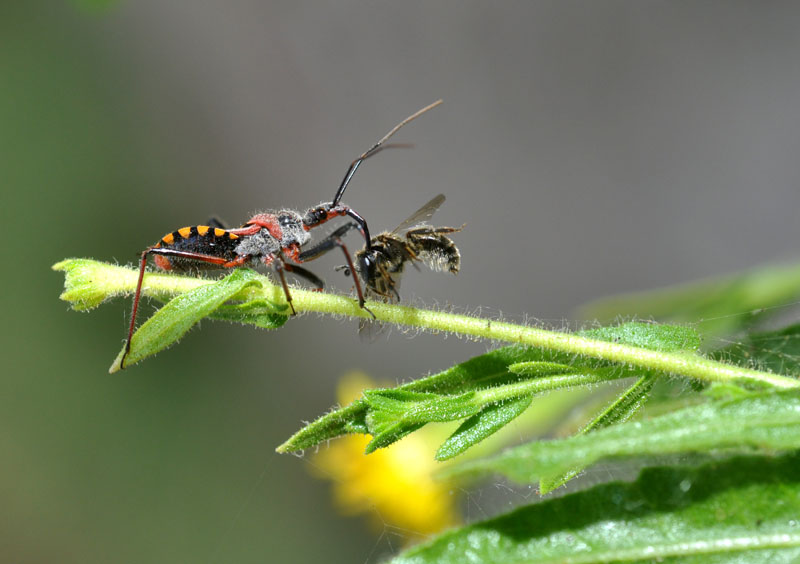
The predatory red assassin bug

The red assassin bug belongs to a large family of predatory insects which have an elongated head, narrowed neck and long legs. They also have a prominent tube which they use for sucking the liquidised contents of their prey. The family consists of about 7,000 species found in most parts of the world including Europe, North and South America and Africa. Twelve species are found in the Maltese islands. The red assassin bug, known in Maltese as seffud tal-assalt is the most common and easily recognised species.
This species can often be found waiting for its prey underneath the flowers of a number of summer-flowering plants especially fennel (busbies), samphire (xorbett) and fleabane (tulliera).
I photographed this specimen last Sunday at Fiddien Valley near Rabat. It had just caught a small bee as it was visiting the flowers of a sticky fleabane (tulliera komuni). The bug inserted its segmented proboscis in the space between the head and the thorax to inject it with a lethal toxin that dissolves its tissue. It then starts to suck up the liquefied tissues through its long proboscis. This process takes several minutes and so I had enough time to take several pictures of the bug as it was feeding.
Assassin bugs are aggressive insects and sometimes capture insects that are larger than themselves. They manage to subdue and kill them by means of their poisonous saliva. Some species of assassin bug feed on cockroaches or bedbugs. Some are beneficial to agriculture as they attack insect pests. In some parts of the world people breed assassin bugs as pets or for insect control.
Some species are notorious for biting humans and one species found mostly in South America can transmit the potentially fatal Chagas disease. (This article was published in The Times on 25.08.2010)